



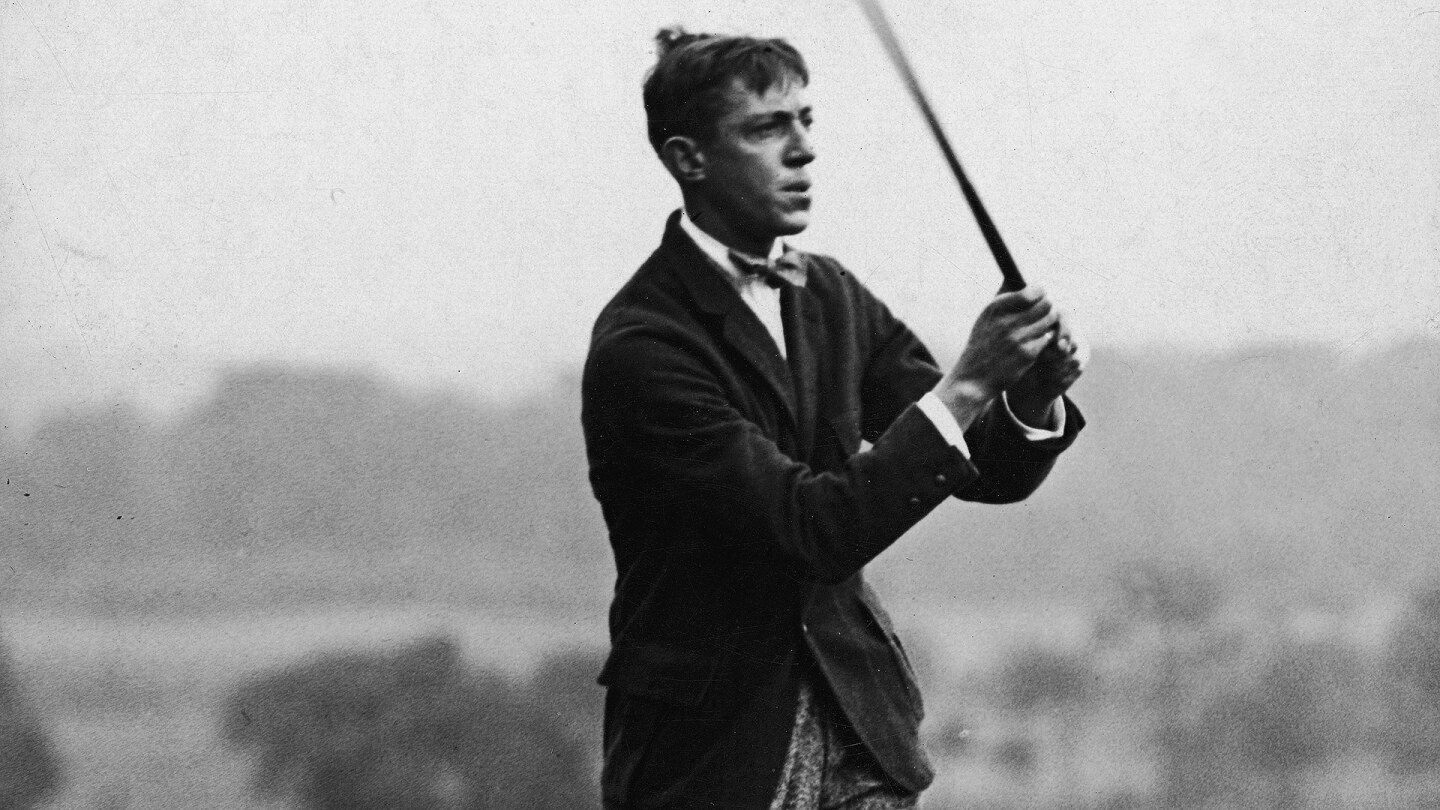
(Editor’s note: This story is part of a series that ran in 2013 on GolfChannel.com, celebrating the 100-year anniversary of Francis Ouimet’s U.S. Open victory.)
Before there was Tiger Woods, there was Francis Ouimet.
Before there was Arnold Palmer, there was Francis Ouimet.
Before there were Bobby Jones and Ben Hogan and Jack Fleck and Jack Nicklaus and John Daly and celebrity caddies and the War by the Shore and the Battle of Brookline, there were Francis Ouimet, Eddie Lowery, Harry Vardon, Ted Ray and the 1913 U.S. Open.
As The New York Times put it in one of its 11 headlines on the result of the 18-hole playoff that took place on Saturday, Sept. 20, 1913: Ouimet Win? Impossible
One hundred years ago at The Country Club in Brookline, Mass., a 20-year-old former caddie walked across the street from his family’s modest house onto the grounds of one of the nation’s most exclusive playgrounds for the rich. Over the span of a week he created the most astounding story in the history of golf.
For the better part of four rounds, Ouimet matched Vardon, one of the immortals of the game, and Ray, another top British player, until finally it seemed that Ouimet had run out of magic. But he rallied with two birdies in the final six holes of regulation, then decisively beat the two veterans in the next day’s 18-hole playoff.
“This made it a front-page sport,” said eight-time major champion Tom Watson, who inherited a love of golf history from his father, Raymond.
The story made the top of Page 1 of The New York Times, an extreme rarity for a sports event. The headline – OUIMET WORLD’S GOLF CHAMPION – was long on enthusiasm if short on accuracy, ignoring the fact that the British Open was 35 years older than its U.S. cousin and still considered golf’s premier tournament.
“This is one of the greatest stories in the 20th century,” said Mark Frost, who titled his 2002 book about the Open “The Greatest Game Ever Played.”
“Not just golf, and beyond sports.”
"(Golf) went from a game of the very elite, elite, elite, meaning the extremely rich, to a game that was more accessible, not totally accessible, but more accessible, than it had been before,” said golf historian and author Martin Davis.
“Golf was a foreign game at the turn of the century, but thanks to what Francis did in 1913, the seed of American golf was planted,” Jack Nicklaus said in a video he made for the Ouimet Fund’s May 15 gala. “Francis set the stage for the likes of Jones, Sarazen, Hagen, Hogan, Nelson, Snead and Palmer. A half a century or so later, I think it’s safe to say that we became the dominant nation in golf.”
“His win encouraged all golfers, especially in America, and helped change the sport’s perception,” Tiger Woods said. Woods, a three-time winner of the U.S. Amateur, also acknowledged Ouimet’s accomplishments in that tournament, which Ouimet always maintained gave him more satisfaction than his Open win. “His two U.S. Amateur wins were significant, too,” Woods said. “I think it’s great that this year’s Amateur will be at The Country Club. It’s an appropriate honor for an outstanding man and his historic feat.”
Ouimet’s centennial Open triumph is being celebrated this year in a big way, from a gala dinner that was held in Boston, to a Ouimet Memorial Tournament at three Boston-area clubs that played a large role in his career, to the 113th U.S. Amateur scheduled for The Country Club and nearby Charles River Country Club in August.
“I try not to get cliche-ish or sappy about it, but it’s an incredible story,” said Curtis Strange, who won the U.S. Open at The Country Club 75 years after Ouimet, in 1988. “It’s a story, if you sent it to Hollywood (as a fictional script) they wouldn’t accept it, because it’s too corny.
“But it’s true.”
Ouimet downplayed his accomplishment over the years – when he spoke about it at all.
“He took it all in stride,” said his daughter, Barbara McLean. “Later in life, when he was awarded some testimonial, he would say, ‘Nobody remembers me.’ ''
He was wrong. In February, Golf World magazine ranked Ouimet’s Open win as the most important moment in golf. In this first installment of a series on Ouimet, GolfChannel.com examines why.
Before there was Tiger Woods, there was Francis Ouimet.
You see it all the time in modern-day media – Tiger Woods doesn’t just move the needle, he is the needle. If that phrase had existed in late September 1913, Francis Ouimet would have been the needle.
Not only did his win make Page 1 of The Times, it got a banner headline on the front page of the Sports section, where it took up seven of the eight columns, including nine sidebars. In contrast, in 1911 when another ex-caddie, professional John J. McDermott, became the first American-born player to win the U.S. Open (and at 19 he was even younger than Ouimet), he got a one-column headline and a three-paragraph article on Page 10 of The Times. Why the difference in treatment? McDermott was a pro, Ouimet an amateur. McDermott, a Philadelphian, had no local connection to the 1911 Open site, Chicago Golf Club. And the two players McDermott beat in an 18-hole playoff, Americans George Simpson and Mike Brady, weren’t exactly household names.
Viewed merely as an upset, Ouimet’s win had a limited shelf life with the general sports fan, whose attention would soon turn to the college football season, where undefeated Harvard would end up being declared unofficial co-national champion with Chicago and Auburn.
But within golf, a sea change was underway, starting with the occupants of the bottom rung of the game’s social ladder.
At The Apawamis Club in Rye, N.Y., a young caddie named Eugenio Saraceni felt the ripples of Ouimet’s earth-shattering win.
Caddies, Saraceni wrote in his 1950 memoir, “Thirty Years of Championship Golf,” under his Americanized name, Gene Sarazen, “received a new lease on life after it was circulated that Ouimet had started as a caddy.
“Instead of regarding the boys as cheap labor, golf clubs began to think of them as human beings in whose ranks there might be another Ouimet who in future years might make the world safe for American golf.”
Sarazen would later become famous for his “Shot Heard ’Round the World” albatross that helped him win the second Masters Tournament. He would also join Ouimet in the initial group of inductees to the World Golf Hall of Fame and later serve as a pallbearer at Ouimet’s funeral.
“The change didn’t take place overnight,” Sarazen wrote, “and Apawamis acted more rapidly than many clubs in decreeing that the caddies should have a tournament of their own.”
In 1927, 14 years after Ouimet’s historic victory, the most famous caddie tournament ever played took place at Glen Garden Golf & Country Club in Fort Worth, Texas. Two teenagers battled over 18 holes, Byron Nelson beating Ben Hogan by a single stroke, both setting off on a path that would lead them, too, to golf’s halls of the immortals.
Just as the mixed-race Woods, more than 75 years later, would by his magnificent accomplishments inspire minorities to take up golf, Ouimet inspired caddies and other members of the working class to try this newfangled game. According to the 1916 American Annual Golf Guide, there were 742 courses in the U.S. By 1920, that number had risen to 1,089, including many municipal and public courses. Statistics on participation are more murky, but likewise show growth. According to the Ouimet Fund, there were approximately 350,000 golfers in the U.S. around 1913. Within 10 years, that figure had skyrocketed to 2.1 million.
And just as Woods has provided financial assistance and college scholarships to the needy with his Tiger Woods Foundation, Ouimet continues to provide college scholarship money through the Francis Ouimet Scholarship Fund, which in 2013 surpassed $26.5 million in scholarships.
Before there was the “War by the Shore” Ryder Cup, there was the 1913 U.S. Open.
Three events over the previous decade elevated the temperature of national rivalry at Brookline, especially on the British side. The first had come in 1904, when Walter J. Travis, a naturalized American citizen from Australia, became the first Yank to win the British Amateur. The second came in 1911, when John J. McDermott became the first American to win the U.S. Open (a title he successfully defended in 1912). The third also came in 1911, when Harry Vardon ended an eight-year drought in the British Open by winning the tournament for the fifth time.
Newspaper magnate Alfred Harmsworth, who held the title of Lord Northcliffe, saw an opportunity to avenge Travis’ and McDermott’s wins and make some money on Vardon’s renewed popularity. The owner of the Times of London and the Daily Mail persuaded Vardon in 1912 to repeat his American tour of 1900 and bring back the same prize he had brought back then – the U.S. Open trophy.
Vardon agreed, but a flare-up of the tuberculosis that had plagued him for the past several years caused him to postpone the trip until the following year.
A popular story says Vardon was booked on the Titanic, but just how close he came to boarding the ship remains an unsolved mystery.
The Americans were just as eager to keep the trophy. After defeating Vardon, Ray and a host of others in a pre-Open tournament at Shawnee-on-the-Delaware, McDermott made an emotional speech to the effect that he would do the same thing to the English stars in the upcoming U.S. Open at Brookline.
Heavily criticized by fellow players and media, McDermott apologized to Vardon and Ray, but the incident only added fuel to the U.S.-vs.-Great Britain fire. As for the Open itself, there is no record of bitter charges of gamesmanship and bad sportsmanship of the kind that marred the 1991 “War by the Shore” Ryder Cup, but the atmosphere was clearly “us vs. them.”
As Walter Hagen recalled in his 1956 autobiography, “The Walter Hagen Story,” when he showed up at Brookline as an unknown pro, he introduced himself to McDermott by saying, “I’m W.C. Hagen from Rochester, and I’ve come over to help you boys take care of Vardon and Ray.”
Ouimet, far too polite to express such an attitude, nevertheless revealed his real sentiments in his victory speech when he said, according to Henry Leach’s report in The American Golfer, “I simply tried my best to keep this cup from going to our friends across the water. I am very glad to have been the agency for keeping the cup in America.”
Before there was Arnold Palmer, there was Francis Ouimet.
On the surface, Ouimet and Palmer couldn’t have been more different. Ouimet wasn’t ruggedly handsome like Palmer, nor did he ever take a final drag on a cigarette, flick it to the ground, then furiously lash at the ball for all he was worth.
Yet fans of both eras saw the same thing – hard-working, humble men of modest roots who believed in earning everything they got and treating people the way they wanted to be treated.
The British golf writer Bernard Darwin, tasked by Lord Northcliffe to chronicle the return of the U.S. Open trophy to England by Vardon or Ray, became enamored of young Ouimet’s game and character.
In “Out of the Rough,” Darwin’s 1932 collection of his writings from the Times of London and Country Life magazine, he resurrected an awkward incident in the fourth round of the 1913 U.S. Open to illustrate:
“When at the fifteenth hole in the afternoon, some imbecile came up and talked to him about his (the imbecile’s) driving, he was answered with a civility that would have been wonderful in far less trying circumstances.”
Such a thing happening in today’s world is inconceivable, yet one gets the idea that Ouimet, had he switched places with Webb Simpson at the trophy ceremony for the 2012 U.S. Open, would have engaged the intruder known as Jungle Bird in conversation, inquired earnestly about his environmental cause, and maybe even passed the hat for him.
Because of his magnetic personality and on-course success, Palmer is credited with igniting the growth of golf in the television era. Because of his endearing personality and monumental achievement in 1913, Ouimet is credited with igniting the growth of the game in this country a half-century earlier.
Before there were Ben Hogan and Jack Fleck, there was Francis Ouimet.
People will argue until the end of time about the biggest upset in golf history. Google that phrase and you’ll find everything from Fleck shocking Hogan in a playoff in the 1955 U.S. Open to ninth alternate and PGA Tour rookie Daly winning the 1991 PGA Championship to 396th-ranked Ben Curtis winning the 2003 British Open to Larry Mize beating Greg Norman and Seve Ballesteros in the 1987 Masters playoff to Y.E. Yang becoming in the 2009 PGA the first player to come from behind in the final round of a major and beat Woods.
There is plenty of evidence to support the contention that Ouimet trumps them all.
Like Ouimet, Fleck out-dueled the top player of the era, Ben Hogan, in an 18-hole playoff. But Fleck was 33, a pro, and had been playing full-time on Tour for six months. Ouimet was 20, an amateur who played when he could get time off from his regular job.
Daly was largely unknown, but he was freakishly long and had an amazingly delicate touch with his short game. He was no one-hit wonder, either, as his 1995 British Open win attests. It was only his deep descent into gambling, drinking and other personal problems that eliminated any shot he had at becoming a great.
Curtis? Mize? Yang? History has shown us two things: that in golf’s modern era, PGA Tour talent has become deep enough that you don’t have to have a big name to win a big tournament, and that the length of the line for holing out to beat Greg Norman rivaled some of those at Disney World.
Before there was Bobby Jones, there was Francis Ouimet.
Ouimet was the first amateur to win the U.S. Open. Others would soon follow – Jerome Travers in 1915, Chick Evans in 1916. World War I interrupted the tournament until 1919, and in 1923 the greatest amateur of all, Bobby Jones, won his first of four U.S. Opens (to go along with three British Opens, five U.S. Amateurs and one British Amateur).
Only 9 when Ouimet won the U.S. Open, Jones later admitted he was inspired by the feat. “That is the first golf I remember reading about in the papers,” Jones wrote in his 1927 book, “Down the Fairway,” “and I began to feel that this was a real game.”
“I would imagine that Ouimet had a real larger-than-life persona to my grandfather simply because, if you stop and think about it, he achieved an almost Tiger Woods-like status by knocking off Ray and Vardon,” said Jones’ grandson, Bob Jones IV.
On the eve of the 1963 U.S. Open at The Country Club, Jones expressed his lifelong appreciation for Ouimet:
“When Francis Ouimet won the Open 50 years ago, he accomplished the first major injection of romance into American golf,” Jones said. “It’s trite to say this now, but one becomes increasingly aware every year that this was a real transformation of a staid old game into a young man’s field of glory. It has been so ever since. There have been many great golfers since Ouimet, but none who gave more to the game. There have been few who played it so well, none who played it more gallantly. As one who was first his awed admirer, later his fellow competitor, and now as always his staunch friend, I salute him with all possible fervor.”
Had it not been for Jones, Ouimet might have won more than two U.S. Amateurs. He reached the semifinals eight other times, but on four of those occasions his opponent was Jones, who won three of the four matches.
When Ouimet won his second U.S. Amateur, in 1931, the year after Jones, fresh off winning the Grand Slam, retired, Ouimet acknowledged the obvious. “There was no Bobby Jones to hurdle, which, with due deference to the other fine lads in the championship,” he wrote in his 1932 book, “A Game of Golf,” “was a distinct factor in my favor.”
Before there was Jack Nicklaus, there was Francis Ouimet.
Unlike Nicklaus, Ouimet was never regarded as the best player of his era or the greatest of all time. But the lifelong amateur shared three distinctions with the Golden Bear. Both made the U.S. Open their first victory in a professional tournament, both won a pair of U.S. Amateurs and both won a “major” championship when many considered them too old to do so (Ouimet’s 1931 U.S. Amateur, when he was 37, and Nicklaus’ 1986 Masters, when he was 46).
Writing in “A Game of Golf” about his thoughts midway through the 36-hole final of his second U.S. Amateur win, Ouimet revealed the doubts that had plagued him as he grew older:
“I reminisced a bit about other championships, thoughts of matches that I had tossed away, the years of disappointments, and mostly the fact that I dearly wanted to prove to my friends that I did have the necessary stamina to go through. Then, as the years had slipped by, there was that dreadful feeling that we all hate to get, that of thinking we have lost our skill, in short, have outlived our usefulness – in my case, perhaps the idea that I had seen my best days.”
“Mr. Ouimet changed the game,” Nicklaus said in his Ouimet Fund video. “His victory showed that golf is a sport driven by values. Golf by its very nature rewards the work ethic, dedication and sportsmanship that Francis Ouimet exemplified. ... The game of golf in America would likely not be what it is today without Francis Ouimet’s influence.”
Before there were famous caddies such as “Creamy” Carolon and “Tip” Anderson and Carl Jackson and Angelo Argea and Steve Williams, there was Eddie Lowery.
Eddie Lowery easily could have been just a sideshow in the Open. Taking over the job of carrying Ouimet’s bag when Lowery’s older brother Jack, who was supposed to caddie, was caught skipping school by a truant officer, 10-year-old Eddie proved to be part psychologist, keeping Ouimet focused with his repeated mantra, “Keep your head down and keep your eye on the ball,” and part bodyguard, keeping unwanted visitors at bay with the tenacity of a bulldog.
In a first-person account of the Open victory, written in the tournament’s immediate aftermath for The American Golfer, Ouimet called Lowery “a veritable inspiration all the way around; and a brighter or headier little chap it would be hard to find. His influence on my game it would be hard to overestimate.”
Ouimet demonstrated his faith in Lowery when before the playoff, he rejected the suggestion of a friend that he replace the youth with a more experienced caddie, namely, the friend.
Lowery became a multi-millionaire businessman as an auto dealer on the West Coast. “He was always grateful for what Francis did for him, sticking with him in that playoff,” said Lowery’s daughter, Cynthia Wilcox. “I am convinced that the reason he was so successful was because of that incident.”
Before there was the 1999 Battle of Brookline, there was the 1913 Battle of Brookline.
Had Ouimet won the Open at another course, his story would have been robbed of one of its most basic angles: Local boy makes good. He lived with his family at 246 Clyde St., directly across from the 17th hole at The Country Club. As a young boy, he would cut across the course going to and from the Putterham School and amassed a collection of stray golf balls, which fueled his early interest in the game.
Fast-forward to 1999 and the night before the final day of the Ryder Cup. The U.S. cause looked hopeless, as the Americans trailed the Europeans, 10-6, going into the Sunday singles, and Europe needed only four points to clinch a tie and retain the cup.
When U.S. captain Ben Crenshaw spoke to his team that night, Davis Love III expected Crenshaw to talk about his mentor, the late Harvey Penick. Instead, Crenshaw told the story of Ouimet and the 1913 Open.
“It was funny,” Love recalled. “I was waiting the whole time for Ben to say ‘Take dead aim’ because that’s what Harvey Penick always said.” But talking about Ouimet “was like he said, ‘I’m not going to do what everybody’s expecting me to say – I’m not going to use Harvey because that’s not what this course is about or what this place is about.’
“It was a history lesson for all of us.”
The U.S. team rallied on Sunday, and when Justin Leonard reached the 17th green all square against Jose Maria Olazabal, all the U.S. needed was a halve to clinch the cup. Leonard sank a 45-foot putt for birdie, triggering a chaotic – and hugely controversial – celebration by the Americans. When the pandemonium subsided and Olazabal failed to make his 25-footer and lost the hole, the U.S. victory and unprecedented comeback were complete.
Crenshaw kissed the green.
Five years later, Crenshaw wrote the foreword for a reprinting of Ouimet’s book, “A Game of Golf.” Crenshaw concluded his six-paragraph essay thusly:
“After our team staged a furious rally to win the cup, I brought two things back with me: a miniature bronze of Francis Ouimet and Eddie Lowery from the Ryder Cup caddies, and the eerie feeling that Francis Ouimet’s spirit guided Justin Leonard’s putt into the seventeenth hole that electric afternoon. No one can convince me otherwise.”
Does Ouimet’s story still resonate, even after 100 years? Does it mean anything to modern players?
“I hope so,” said Strange, who felt as much pride in becoming part of the extended Ouimet/Country Club storyline in 1988 as he did in winning the Open itself. “I hope so because it’s all part of the game that you play.
“It’s all part of the fun.”