



Bailey Shoemaker is grateful she could celebrate this anniversary.
Exactly one year from last Wednesday, Shoemaker struck a 3-wood on her second hole during the final round of the Charles Schwab Women’s Collegiate and immediately felt a shock through her right arm. The debilitating pain tormented her for nearly seven months, ultimately forcing surgery and shelving her longer than she’d ever been away from the game.
But now, the 21-year-old Shoemaker is back, healthy and competing again at a high level, only this time with a newfound perspective.
“I do fully understand and believe that it is a privilege to be able to do what I do,” Shoemaker said. “I didn’t know how much longer I could do this for. I didn’t know when the pain would ever go away. Being able to do it now, pain-free, and knowing that I’m healthy and I’m good, and mentally doing better, too – even just to swing a golf club; honestly, it’s little, but I’m very appreciative. Before I got hurt, I was kind of still a punk kid. I’ve grown up a bunch this last year.”
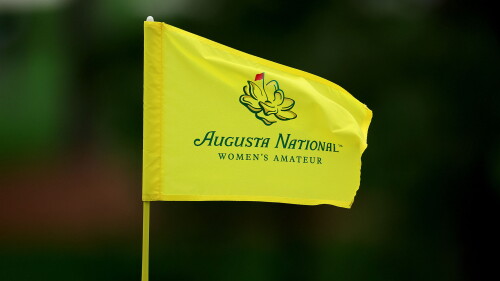
Shoemaker seemed poised to take off following her runner-up finish at the 2024 Augusta National Women’s Amateur, which was capped by a tournament-record, 6-under 66 that Saturday at Augusta National Golf Club. She placed second a few weeks later at the NCAA East Lansing Regional and made runs at that summer’s Women’s British Amateur and U.S. Women’s Amateur. But that one shot at Colonial last March changed everything.

Initially, Shoemaker figured it was her tendonitis flaring up, so she slipped on the wrist brace that she carried in her bag. It didn’t help.
“Every time I got to the top my swing, I would get a super bad shooting pain, and it would go into my fingers, and my ring and pinky fingers would lose feeling,” said Shoemaker, who’d play five more events that spring, including ANWA, where she missed her third cut in four tries, and the NCAA Championship, where the issue got so bad, her last two fingers would come off the club at the top.
Doctors recommended Shoemaker, who’d never taken more than a week off before, put the clubs away for the entire summer, so she instead spent two hours per day, seven days a week doing physical therapy in hope of avoiding surgery. She also took a job at Hillcrest Country Club in Los Angeles, working a summer camp for juniors. Her shifts for camp would usually go from 6:45 a.m. to noon, then she’d head straight to rehab, where she’d be until around 5 p.m.
Shoemaker returned in the fall to qualify for the Trojans’ first tournament, but USC head coach Justin Silverstein and the team’s medical staff could tell Shoemaker was still hurt.
“Just sitting in class and sleeping at night, I was in excruciating pain,” Shoemaker said.
After switching doctors, she was diagnosed with cubital tunnel syndrome, which causes the ulnar nerve to be compressed at the elbow. While Shoemaker wanted to continue playing through the issue and put off surgery until winter break, Silverstein stepped in.
“If we think surgery is going to be an option, then I’m shutting you down immediately,” he told Shoemaker in a meeting. “I don’t want you to have to go through what you did last spring, so let’s get you 100% better.”

In the moment, Shoemaker admits she wasn’t happy about missing the entire fall. But on Oct. 16, she had surgery, which was followed by a six-week recovery time that ended on Thanksgiving Day, when she could putt for 5 minutes. Her first nine-hole round came on Christmas Day, and from there, Shoemaker attacked her rehab aggressively. She’s added strength and picked up 4-5 mph of clubhead speed from where she was pre-injury.
And in five starts this spring for USC, she’s yet to finish worse than T-12. Her best finish came at the GameAbove Invitational, where she was second.
“I have put in an egregious amount of work ever since nationals ended to be where I am now,” Shoemaker said. “I still work out twice a day, five days a week, just trying to get stronger and do all these things to be able to play now. I’ve worked my ass off, so I’m not necessarily surprised.”
While she’s technically still on a ball count, Shoemaker sees it more as her new normal – “I don’t know if I can ever do it again like I used to, and honestly, I don’t know if I should,” she said. The only hurdle that remains is psychological.
“I have a bit of a mental battle going on right now,” Shoemaker reveals. “Just trying to reassure myself that there isn’t pain anymore. I’ve been struggling with it for the last four months, just being fully committed to hitting the ball.”
While Shoemaker has made strides in reinforcing her mind, she’ll sometimes still get to the top of her backswing and stop. Silverstein has seen similar with other athletes returning from serious injury.
“It’s not easy what she’s going through as far as being able to swing comfortably and confidently,” Silverstein said. “She’s taking it back and her brain is still firing like it’s going to hurt, and that’s how she played all last spring. For her to be able to fight through that and play like she has, it’s incredible. She’s a tough, tough dude, man. And we knew that, but I think she’s tougher than she thought.”

Silverstein remembers Shoemaker’s runner-up at ANWA like it was yesterday. He said that performance proved to Shoemaker that she could compete on the biggest stage and when she’s most nervous.
This version of Shoemaker, however, is “way better,” he says.
“She hits it farther, higher,” Silverstein explains. “Her wedge game is just as good. She’s more diverse around the golf course with what she can do because it’s not so hooky and one shape. And she has better golf strength; she’s physically stronger, but she’s also mentally stronger. I think she’s a much more complete golfer, so if things are going right and she’s in contention, I think she can win. I would put that on her; I don’t think that’s any extra pressure. She’s capable of winning.”