AUGUSTA, Ga. – This one was supposed to be easier.
Rory McIlroy said it himself a few days ago. Now a Masters champion, he could make the swings needed to win again at Augusta National Golf Club, free of worry, knowing that no matter what happened he could trot on up to the Champions Locker Room afterward, slip into his green jacket and crack open an ice-cold Coke Zero.
Turns out, they’re all hard.
The only difference this year is that McIlroy’s hair was considerably longer and more gray as he ran his fingers through it, exhaling in relief after yet another dramatic win. McIlroy coughed up the largest 36-hole lead in tournament history, in just 18 holes, and entered the final nine on Sunday three back of a familiar face, Justin Rose, the man he beat in last year’s playoff. But again, McIlroy dug deep, this time playing Amen Corner brilliantly and riding his short game to a one-shot victory.
“I thought it was so difficult to win last year because of trying to win the Masters and the Grand Slam,” McIlroy said, “and then this year I realized it’s just really difficult to win the Masters.”
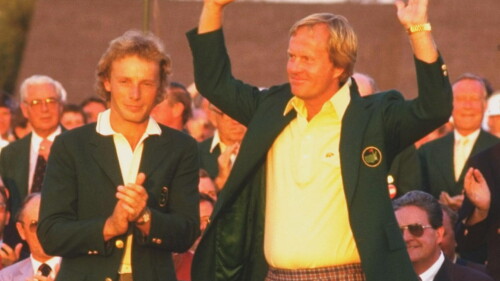
McIlroy, now with six major titles to his name to tie Nick Faldo for most all-time among Europeans, joined Faldo, Jack Nicklaus and Tiger Woods as the only players to capture back-to-back Masters.
After Scheffler helped McIlroy into his first green jacket, McIlroy said he looked forward to putting the jacket on himself in a year’s time.
“I wasn’t quite correct,” said McIlroy, who was assisted on Sunday evening by Chairman Fred Ridley, not a solo effort. “But I did want to prove that last year wasn’t a fluke.”
Though McIlroy hadn’t competed since pulling out of the Arnold Palmer Invitational four weeks ago with a minor back issue, he believed that he entered this week’s Masters not only with a clearer mind but more prepared than ever. He spent so much time at Augusta National in recent weeks that he joked it had become his home course. There were some days when he’d drop his 5-year-old daughter, Poppy, at school, fly from Jupiter, Florida, to Augusta, play some holes and be back home in time for dinner.
Borrowing some wisdom from Nicklaus, McIlroy tried to simulate tournament rounds as best he could on those trips. It was, of course, impossible to replicate what transpired over these past few days.
For 48 hours, McIlroy looked unbeatable. Fred Couples said Friday afternoon as McIlroy was orchestrating a 7-under 65 to jump a whopping six strokes clear of the field, “Rory may never lose this thing again.” McIlroy’s pals Shane Lowry and Tyrrell Hatton were jokingly waving their metaphorical white flags when they saw McIlroy the next day in player dining. McIlroy responded by telling them, “Boys, there’s a long way to go.”
Boy, was he right. McIlroy struggled with his ball-striking, particularly with a left miss, and came crashing back to the field with a Saturday 73 on a day when Augusta National played the easiest it ever had in a third round. Now tied with Cameron Young for the lead at 11 under, McIlroy put on a calm face in his post-round interview but then bolted straight to the tournament practice area, where he hit exactly 47 balls, most of them short-irons and wedges. By the time McIlroy stepped on the range Sunday morning, he’d straightened himself out.
Young’s Masters Sunday began like any other Lord’s Day. He and his family – wife, Kelsey, and their children, Henry, John and Vivienne – attended Catholic mass at a nearby church. Seventy years ago, Jack Burke nearly missed his Masters tee time after the church service he was at started a half hour late. Burke arrived at Augusta National with just 15 minutes to warm up, though he then made up eight shots on overnight leader Ken Venturi to complete the largest comeback in tournament history and win his only green jacket.
While Young rolled down Magnolia Lane with plenty of time to spare, his major prayers would not be answered. He quieted the largely pro-McIlroy crowd early with a nifty pitch that barely cleared the right greenside bunker and ensuing birdie at the par-5 second to take his first lead. He then led by two shots after McIlroy shockingly three-putted from 9 feet at the par-3 fourth.
Young, who opened his week with a first-nine 40, displayed major-worthy ball-striking for much of the tournament and missed just one green on the second nine on Sunday. But with the putter, he could get nothing to fall.
“If you go through the back nine, I pretty much had a birdie chance on every hole and didn’t make any,” said Young, who had especially good looks on both par-5s, Nos. 13 and 15. “That’s how it goes sometimes. … Any one of those, or three of them, could have gone in and be a different story.”
Instead, McIlroy followed a familiar script. Nicklaus’ recent piece of advice to McIlroy was, “No effing double bogeys,” though McIlroy couldn’t help himself. Last year, he doubled the first hole on Sunday; this time, that double came three holes later. He bogeyed the par-3 sixth, too, to return to single digits, right as Rose was mounting his charge. Rose capped his first-nine 32 with three straight birdies, seemingly headed toward a place in the record books; had he won, in his 21st career Masters start, it would’ve been the longest wait for that first green jacket ever.
Unfortunately for the 45-year-old Englishman, he fell apart at Amen Corner with bogeys at Nos. 11 and 12 and eventually signed for 70, ending in a four-way tie for third at 10 under.
“I feel like with a sudden-death loss, you kind of know you got to the house, you’ve done everything it took to win, then it comes down to flick of a coin at times,” Rose said. “Whereas today, I felt like, yeah, there was an opportunity to do better, so obviously that is frustrating.”


McIlroy stayed in the game with birdies at Nos. 7 and 8, but as he turned for home on Sunday afternoon, the winds began to gust harder than they had in days. The breeze was a nice reprieve from the warm temps, but it also meant that McIlroy, already feeling a sense of déjà vu, would face heightened difficulty on a second nine where he carded just two pars and shot 2 over in last year’s final round. If McIlroy repeated history, an overall repeat would be highly unlikely, which would’ve been, McIlroy admitted later, a “bitter pill to swallow” considering the earlier cushion.
But McIlroy was much more controlled this time. Maybe he was right about the green jacket’s medicinal benefits. McIlroy’s mantra all week was to just keep swinging, and his best swing came where Masters are usually lost, at the par-3 12th, also known as Golden Bell, which played 161 yards with the wind back and off the left, though also swirling.
McIlroy had just regained the solo lead as he waited to hit his tee shot, a perfect, three-quarter 9-iron. With the wind suddenly feeling as if it’d changed direction, McIlroy paused longer, thinking back to his very first Masters practice round, in 2009, when Tom Watson told him to wait to hit until the wind is where it should be, then hit the shot as soon as you can. When the wind was just right, McIlroy aimed at the middle of the bunker and watched his tee ball cut right, farther right than anticipated, before it landed on the green and kicked toward the hole to 7 feet.
The ensuing roar rocked Augusta National the hardest it’d been rocked all week. Out of sight, a young boy heard the noise and asked his dad, who was likely trying to beat traffic, “Was that for Cam?” The father replied, “No, that’s Rory. Too loud.” (Young would give himself a 14-foot look at birdie on the hole, but he missed the putt.)
“That was a really good golf shot at the right time,” McIlroy said, “and probably a golf shot I wouldn’t have been able to hit yesterday if I didn’t go to the range and try to figure a few things out and try to neutralize the ball flight a little bit. Yeah, absolutely huge, huge shot.”
McIlroy hit the fairway on the par-5 13th hole for the first time since Tuesday’s practice round, then added his final birdie of the tournament to stretch his lead to three shots. Scheffler cut the gap to two with back-to-back birdies, at Nos. 15 and 16, but he’d settle for a closing 68, 11-under week and his third career runner-up in a major.
Still at 13 under after a clutch Texas wedge from behind the 16th green to save par, McIlroy told himself on the par-4 17th tee box, “I just need four more good swings.”
“I made one,” McIlroy added with a laugh.
None was worse than McIlroy’s final tee ball, a 266-yard slice into the trees.
“Walking off the 18th tee, not knowing where my ball was; I think that was the moment of greatest stress,” McIlroy said. “It could go anywhere. It could be anywhere.”
But when McIlroy arrived at his ball, sitting in the pine straw, he had a window. From 179 yards out, he cooked a big draw – like the one he struck on the 15th hole a year ago – around the pines, over the scoreboard and into the left greenside bunker. He then blasted out to 12 feet and with a shot to work with, missed his par putt by a couple inches.

As Augusta National member John Carr, son of Irish legend Joe Carr, described later to McIlroy, “Never a dull moment.”
Before tapping in, McIlroy glanced behind the green at his family – Poppy; wife, Erica; and his parents, Gerry and Rosie, who had missed the first Masters win, watching instead from back home in Holywood, Northern Ireland, where McIlroy and his caddie, Harry Diamond, grew up. McIlroy wasn’t as emotional as he was last time, though the most choked up he did get was when he honored his parents during the trophy ceremony, saying, “If I can be half the parent to Poppy that you were to me, then I know I’ve done a good job.”
“I caught myself on the golf course a couple of times thinking about them, and I was like, no, not yet, not yet,” McIlroy said. “Yeah, it’s really cool to have them here. They missed it last year, and the first thing I wanted to do was fly home to see them because I obviously wouldn’t be sitting up here if it wasn’t for them. I had to sort of convince them to come this year because they thought the reason I won last year was because they weren’t here. I said on the putting green that I’m glad we proved that wrong, so they can keep coming as long as they want.”
Achieving the career slam was the destination, or so McIlroy thought. He struggled in the ensuing months last spring and summer trying to rekindle his competitive motivation. He eventually found it, winning a second Irish Open and a sixth Ryder Cup. McIlroy, at 36, says he still has plenty left to achieve, most notably leaving no doubt as the greatest modern European player ever.
McIlroy’s 45 worldwide wins are two more than Faldo, who had already conceded McIlroy’s bona fides were better than his after last year’s Masters triumph. McIlroy likely won’t touch Seve Ballesteros’ 50 European Tour titles, but his 30 PGA Tour victories are 21 more than the five-time major winner. And his six Ryder Cup wins are one more than Faldo and Ballesteros combined. McIlroy surely isn’t done, either.
“I’m not putting a number on it,” McIlroy said, “but I certainly don’t want to stop here.”
After waiting 17 years and then rattling off two in a row, McIlroy can become the only player in Masters history to win three straight green jackets when he shows up to Augusta National next year. For now, though, McIlroy will enjoy this one, just with something a little stiffer than soda.
What’s more refreshing than being a Masters champion?
Well, for one, being a two-time Masters champion.